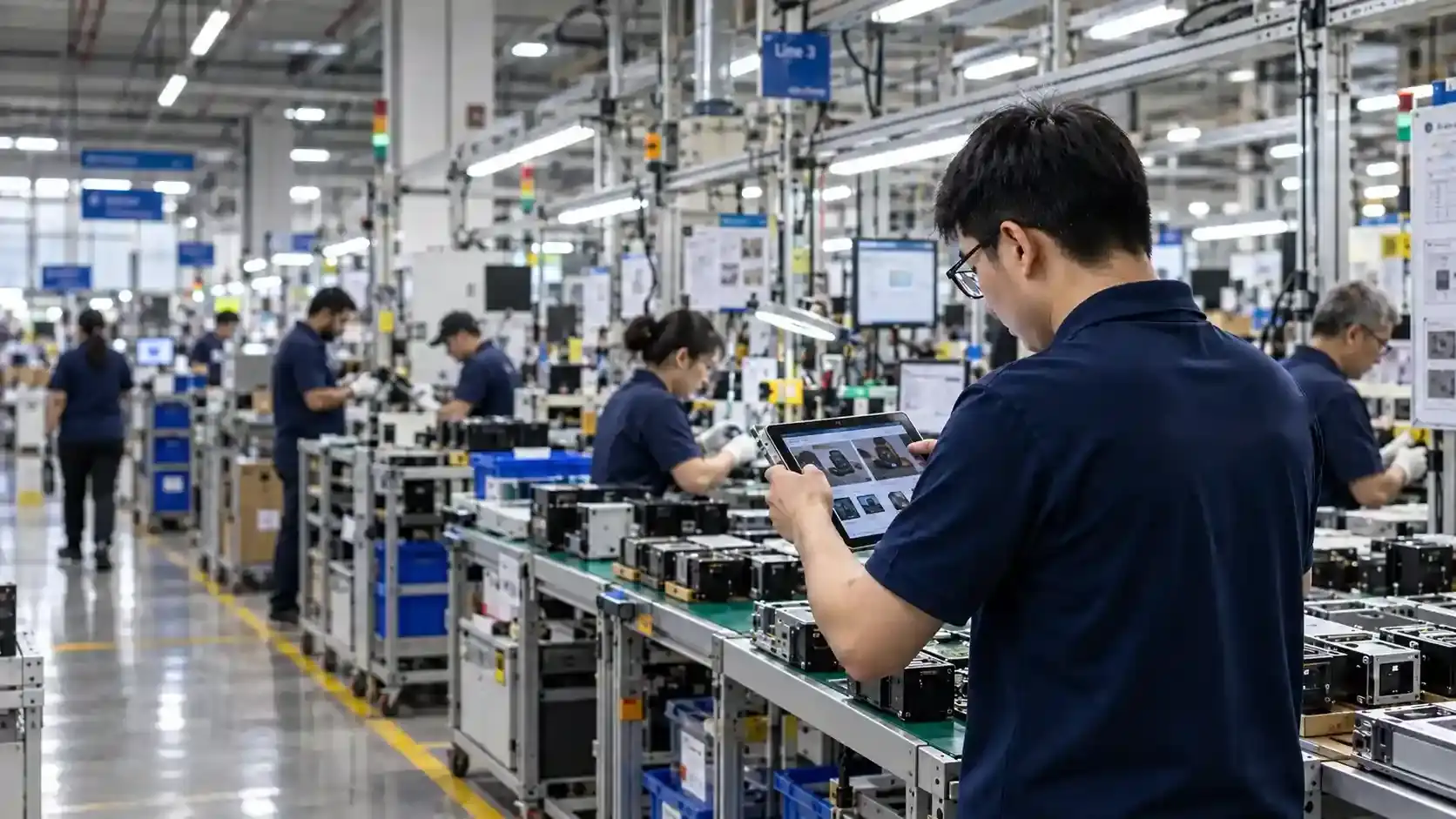
Quality control for products made in China should not begin when cartons are ready to ship. If a supplier starts production using an outdated drawing, an unapproved material or an unclear acceptance criterion, a final inspection may discover the problem only after time and money have already been spent.
A stronger process combines prevention before production, targeted checks during production, and verification before shipment. The right controls depend on product complexity, order value, regulatory risk and the cost of failure. Not every order needs every possible inspection, but every order should have a clear specification and an agreed process for handling deviations.
Quality control vs. inspection vs. testing
- Quality planning: defines the requirements, responsibilities, process controls and acceptance criteria before work begins.
- Production quality control: monitors materials and processes to prevent defects and identify problems while they can still be corrected.
- Product inspection: checks selected units or batches against agreed requirements at a defined stage.
- Laboratory testing: measures specific technical, safety or material properties using a suitable method and sample.
These activities complement one another. A factory audit assesses the supplier’s systems and capabilities; a product inspection checks selected goods. Neither replaces a clear specification or product-specific testing when testing is required.
Stage 1: Define the quality requirements before ordering
Write down what “acceptable” means before asking for a quotation or approving a sample. Requirements should be measurable wherever practical and specific enough that the buyer and supplier can apply them consistently.
Include the following as relevant to the product:
- Materials, components, dimensions, tolerances, finish, colour and functional requirements.
- Approved drawings, artwork, labels, packaging and document revision numbers.
- Destination-market safety, labelling, testing or certification requirements that apply to the product.
- Critical, major and minor defect examples, where that classification is suitable.
- Inspection method, sample selection approach and any agreed acceptance limits.
- Who can approve a deviation and how that approval must be recorded.
- What happens after a failed check: containment, rework, retest, replacement, refund discussion or another agreed remedy.
A phrase such as “good quality” is not an acceptance criterion. If a dimension is critical, specify the target and tolerance. If colour matters, identify an approved reference and the method used to compare it. If performance or safety matters, define the appropriate test and acceptance rule with a qualified specialist when necessary.
Stage 2: Approve the sample and freeze the specification
For a new or customised product, sample approval is an important control point. Record the sample reference, materials, version, measurements, functional results, packaging and any approved deviations. Keep dated photos and the final specification together so that the production team can identify the approved reference.
Ask the supplier whether the sample uses the same material, tooling and process intended for mass production. If it is a hand-built or pre-tooling sample, identify the differences and decide what additional approval is needed before the production run.
After approval, freeze the specification revision for the order. If either party proposes a change, record the reason, impact, required tests and approval before implementation. A sample is a reference for production, not a guarantee that the entire batch will match it.
Stage 3: Check incoming materials and production readiness
Before mass production begins, confirm that the supplier has the approved documents, materials, components, packaging and production plan. This is where an initial production check (often called IPC) may be useful, particularly for customised, high-risk or unfamiliar orders.
| Control point | What to confirm | Evidence to retain |
|---|---|---|
| Material identity | Material or component matches the approved requirement and is traceable where necessary | Labels, batch/lot information, supplier records or relevant test documents |
| Production setup | Correct tooling, settings, work instructions and specification revision are being used | Setup records, approved samples, work instructions or photos |
| First-off product | Early units meet critical dimensions, function, appearance and assembly requirements | Measurements, test records and approval decision |
| Packaging readiness | Labels, artwork, carton configuration and protective materials are correct | Approved packaging sample and document revision |
| Capacity and schedule | Production plan and key milestones are plausible for the order | Milestone plan, quantities and identified constraints |
Do not treat a supplier’s statement that “materials are ready” as equivalent to verification. The appropriate evidence varies by product: a basic stock item may need a simple confirmation, while a safety-sensitive or highly customised item may require traceability or testing.
Stage 4: Monitor production while changes are still manageable
A during-production inspection (often called DUPRO) can check whether the process is following the approved requirements while some production remains unfinished. It is especially useful when defects could repeat across a large batch or when rework becomes expensive after assembly or packaging.
Choose the timing based on the production process and the likely failure modes. There is no single percentage that is correct for every order. A check should happen early enough to allow corrective action and late enough to observe meaningful production output.
During production, consider checking:
- Whether materials and components match the approved version.
- Whether early or randomly selected units meet critical requirements.
- Whether workers follow the approved process and work instructions.
- Whether defect patterns, rework or scrap are increasing.
- Whether substitutions, tooling changes or subcontracting have been approved.
- Whether quantities and milestone dates remain consistent with the plan.
Ask for evidence tied to the actual order: dated photos, measurements, production records, defect counts or an independent inspection report. Generic factory photos do not prove that your specific order is on schedule or meeting its specification.
Stage 5: Use corrective action instead of accepting vague reassurance
When a check fails, define the immediate containment and the decision needed before production continues. The supplier should identify affected quantities, explain the likely cause, propose a correction and state how the corrected output will be verified.
A useful corrective-action record includes:
- What requirement failed and how the failure was detected.
- Which batches, materials or units may be affected.
- Whether production or shipment must pause under the agreed process.
- The root cause, if known, and the immediate containment action.
- The proposed correction, owner and completion date.
- The retest or reinspection method and the evidence required to close the issue.
- Whether the approved sample, specification or production process needs to change.
Do not approve a deviation only because a deadline is close. If the change affects safety, regulatory compliance, function or a critical specification, get the appropriate technical or compliance review before accepting it. Record any buyer-approved concession explicitly.
Stage 6: Conduct pre-shipment inspection before goods leave
A pre-shipment inspection (PSI) is a final product check near the end of production. QIMA describes its PSI service as an on-site inspection commonly performed when at least 80% of an order is complete. The exact timing and scope should be agreed with the inspection provider and adapted to the product and shipment.
A PSI may cover:
- Quantity and carton count.
- Appearance and workmanship defects.
- Dimensions, materials, function and other product-specific requirements.
- Labels, artwork, manuals and packaging.
- Carton markings, packing configuration and other shipment details.
- Sampling and defect classification under the agreed inspection plan.
A pre-shipment inspection is a sample-based check unless the agreed scope states otherwise. It does not mean every unit has been tested. The result should be interpreted against the agreed acceptance criteria, sample size, defect classification and limitations of the inspection.
For a detailed checklist focused specifically on this stage, see the pre-shipment inspection guide. The present article covers the full quality-control lifecycle, including controls that should happen before the final inspection.
Understand AQL and sampling correctly
Some inspection plans use statistical sampling procedures such as ISO 2859-1, often discussed alongside Acceptable Quality Limits (AQL). These methods help define how a sample is selected and how findings are evaluated under the selected plan.
AQL is not a promise that a batch contains no defects, nor is it a universal pass percentage that should be copied into every purchase order. The appropriate sampling plan, inspection level, defect categories and acceptance/rejection numbers depend on the product, order size, risk and agreement between the parties. For safety-critical or regulated characteristics, sampling may not replace required testing or other controls.
Agree the sampling plan and defect definitions before inspection. If the parties have not agreed them, an inspector may be unable to make a decision that matches the buyer’s intended acceptance policy.
Stage 7: Check loading and shipping readiness
Product quality can still be undermined by wrong quantities, mixed batches, damaged cartons or incorrect loading. Depending on shipment value and risk, a container-loading check may help confirm that the correct goods are loaded and handled according to the agreed plan.
Before dispatch, reconcile the final inspection result, approved deviations, quantity, packing list, carton details, shipping marks and relevant export documents. Confirm who authorises release and what happens if a material discrepancy appears. Loading checks and document checks are not substitutes for product testing, but they address different risks in the final handover.
Build a risk-based quality-control plan
Not every product requires an expensive inspection at every stage. Choose controls based on the likelihood and consequence of failure, how quickly a defect can be detected, and how costly it becomes to correct later.
| Order profile | Possible control plan | Key caution |
|---|---|---|
| Simple, low-risk stock item | Clear specification, supplier confirmation, sample or reference check where useful, final quantity/condition check | Low risk does not mean requirements can remain vague |
| New customised product | Specification freeze, sample approval, initial production check, suitable final inspection | Confirm differences between sample and mass-production process |
| High-volume batch with expensive rework | Incoming material controls, early production checks, during-production inspection and final inspection | Schedule checks early enough to allow correction |
| Safety-sensitive or regulated product | Qualified compliance review, required testing, traceability and risk-appropriate independent inspection | A visual inspection alone cannot establish regulatory conformity |
| Supplier with repeated defects | Root-cause analysis, corrective-action verification, tighter process checks and possible follow-up audit | Do not treat a single passed final sample as proof the process is fixed |
Quality-control responsibility matrix
Agree who owns each activity. Responsibilities may be shared, but they should not be left implicit.
| Activity | Typical owner to agree | Record or deliverable |
|---|---|---|
| Specification and acceptance criteria | Buyer, with supplier and technical input | Approved specification and revision history |
| Production process control | Manufacturer | Work instructions and process records |
| Independent inspection | Buyer books or approves; inspection provider executes agreed scope | Inspection report and findings |
| Corrective action | Supplier proposes and implements; buyer approves material concessions | Action log and verification evidence |
| Regulatory testing | Buyer and qualified compliance/testing providers, with supplier support | Applicable test reports and conformity documents |
| Shipment release | Party specified in the contract and shipping plan | Written release decision and shipping documents |
The matrix is a planning example, not a universal allocation of legal responsibility. Confirm the final responsibilities in the contract and the agreed service scope.
Copyable quality-control checklist
BEFORE PRODUCTION
- Specification, drawing and revision approved
- Materials, packaging and labels defined
- Sample approved against written criteria
- Inspection and testing scope agreed
- Defect categories and acceptance criteria documented
- Change-control and corrective-action process agreed

DURING PRODUCTION
- Incoming materials and components checked as required
- First-off units reviewed
- Production milestones and quantities tracked
- Critical dimensions and functions checked
- Deviations and substitutions approved in writing
- Defects recorded with containment and corrective action

BEFORE SHIPMENT
- Inspection plan and sampling agreed
- Finished goods checked against approved specification
- Quantity, cartons, labels and packaging verified
- Failed checks and corrective actions closed or formally resolved
- Packing list and shipment details reconciled
- Shipment release authorised by the agreed party

AFTER DELIVERY
- Receipt quantity and visible condition checked
- Customer or warehouse issues recorded
- Defects linked to lot/order where possible
- Supplier performance reviewed
- Corrective actions carried into the next order
Frequently asked questions
Is a pre-shipment inspection enough?
It may be suitable for some low-risk orders, but it cannot prevent every production error or verify every unit. For new, customised or high-risk products, earlier controls can identify problems before the entire order is completed.
Should I inspect 100% of the order?
Not automatically. The right approach depends on defect severity, inspection feasibility, product risk, contract requirements and the cost of failure. Some characteristics may require 100% checks or specific tests, while others may be assessed through an agreed sampling plan. Get specialist advice where needed.
Does an independent inspection guarantee product quality?
No. It provides findings within a defined scope, sample and point in time. Inspection cannot establish every characteristic or guarantee that defects will never occur. Clear requirements and process controls remain essential.
Who should pay for reinspection after a failed result?
Agree the rule in the purchase contract or inspection arrangement before production. Responsibility may depend on the cause, the agreed terms and whether the supplier’s output failed the approved requirements.
Final takeaway
Effective quality control is a connected process: define acceptance before ordering, approve a meaningful sample, verify materials and setup, check production at risk-appropriate points, resolve failures with evidence, and verify goods before shipment. Use a factory audit to assess supplier systems and product inspection to assess goods; do not confuse either with a guarantee. If you need help organising supplier information or coordinating agreed procurement steps, review Sourzio’s China sourcing support and confirm the specific service scope before proceeding.