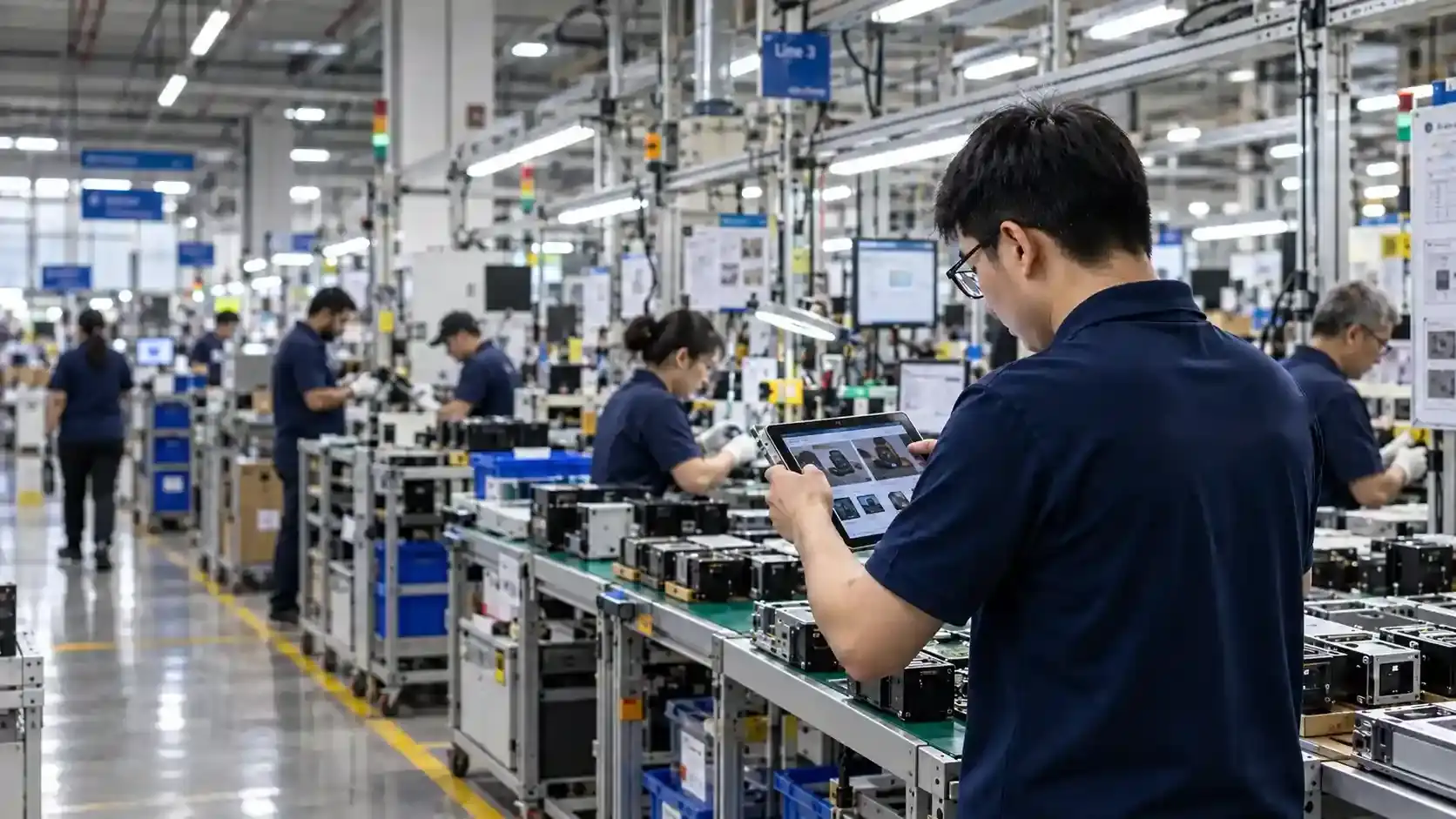
Buying directly from a Chinese manufacturer can be a good fit when the buyer knows what to specify, can communicate technical requirements, and has a plan for samples, quality checks, shipping and issue resolution. It can also create extra work if the buyer expects the factory to handle export coordination, multiple suppliers, documentation or product development without confirming those responsibilities.
The right comparison is not simply “factory versus middleman.” It is a comparison between two complete operating models: what each party will do, what it will cost, what evidence it can provide, and who is accountable when something changes or goes wrong.
What does “buying direct” mean?
In a direct purchase, the buyer contracts with the manufacturer or the entity represented as the manufacturer. However, several roles can still be different: the legal seller, factory operator, exporter, freight forwarder and payment beneficiary may not be the same entity. The arrangement can be legitimate, but each role should be understood and documented.
Compare three common models:
| Model | Potential advantages | Responsibilities to clarify |
|---|---|---|
| Direct factory purchase | Direct technical discussion, visibility into production and potentially fewer commercial layers | Specification control, sample approval, supplier verification, quality follow-up, export documents and logistics coordination may fall more heavily on the buyer |
| Trading company or export supplier | May coordinate multiple factories, consolidate products, communicate in a preferred language or manage export processes | Identify the actual producer where relevant, subcontracted steps, markups, quality accountability and the contracting entity |
| Sourcing or procurement service | Can provide defined research, comparison, coordination or follow-up work without the buyer managing every task alone | Confirm exact deliverables, independence, fees, conflicts of interest, liability limits and which activities are excluded |
None of these models is automatically best. A direct factory can be highly capable or poorly organised; a trading company can add useful coordination or simply obscure the supply chain. Evaluate the actual people, process and commercial arrangement rather than the label.
1. Compare total cost, not only factory unit price
A direct factory quotation may exclude work that another supplier includes. Before comparing prices, list the costs that apply to your order and mark each as quoted, excluded, estimated or unknown.
| Cost item | Questions to ask |
|---|---|
| Product price | Is the price tied to the same specification, quantity, variants and currency? |
| MOQ and variants | Does each colour, size, logo or packaging option have a separate minimum? |
| Sample and revisions | What are the sample, courier, tooling and revision costs? |
| Tooling and setup | Who owns paid moulds, dies, artwork or fixtures, and can they be transferred? |
| Packaging and labels | Are retail packaging, export cartons, inserts and destination labels included? |
| Testing and compliance | Which tests or documents are needed for the product and destination, and who pays? |
| Inspection and rework | Who arranges inspection, how are defects handled, and who pays for rework or reinspection? |
| Domestic transport and export handling | Who arranges factory pickup, warehouse receiving, export formalities and related fees? |
| International freight and destination charges | Which transport services, duties, taxes, insurance and local charges are included or excluded? |
| Coordination time | Who handles translation, clarifications, milestone tracking, document corrections and issue escalation? |
Use a comparison model such as:
Estimated total landed cost =
product cost
+ samples and setup
+ packaging and required testing
+ inspection and expected rework allowance
+ origin handling and transport
+ international freight and insurance where applicable
+ duties, taxes and destination charges
+ coordination and other project costs
This is a planning model, not a universal accounting formula. Some charges may already be included in the quoted price; do not add them twice. Duties and taxes depend on product classification, origin, destination and applicable rules. Get transaction-specific quotations and advice where needed.
2. Confirm who you are contracting with
Ask for the legal name of the seller in Chinese, its registration details where applicable, the contracting address and the identity of the party that will invoice you. If the factory site, seller, exporter or payment beneficiary is a different entity, ask why and request supporting documentation.
Before sending funds, compare the beneficiary details with the agreed contract and independently confirm any change in bank instructions using a previously verified communication channel. Do not rely only on a new email or message containing updated account details. An unexplained mismatch should pause payment until it is resolved.
A business registration record can help establish identity, but it does not prove manufacturing capability, financial strength, product quality or future performance. Combine identity checks with product-specific evidence and a clear transaction structure.
3. Check manufacturing capability, not just factory claims
Ask which process steps are performed in-house, which are subcontracted and who controls the final product. A manufacturer may legitimately outsource plating, printing, packaging or another specialised process; the key is whether those steps are disclosed and controlled.
Useful questions include:
- Which equipment or production process is relevant to this product?
- What is the capacity constraint for the requested quantity and delivery window?
- How are materials, production changes and nonconforming items controlled?
- What records can be shared for the relevant process or product?
- What needs to be approved before mass production starts?
Where the order value or failure risk justifies it, consider a site visit or independent assessment with a defined scope. A video walkthrough can provide context, but it is not the same as a formal audit and cannot prove every operational claim.
4. Do not skip samples and acceptance criteria
A sample helps reveal whether the supplier understands the product, but a sample alone does not guarantee production consistency. Before paying for a sample, define what version will be made, which materials and processes will be used, whether tooling is final, and what tests or measurements matter.
Keep a written sample approval record with the sample reference, photos, measurements, approved deviations and date. The purchase order should point to the same specification revision. If a change is required, document it and decide whether a new sample or test is necessary before production proceeds.
For safety-critical or regulated products, use appropriate specialist testing rather than relying on appearance or a supplier’s informal assurance. The appropriate test depends on the product and destination market.
5. Put quality and change control into the order
Before production, agree on the specification, packaging, inspection method, acceptance criteria, defect handling, rework, replacement or refund arrangements, and who pays for additional checks. Define how changes to material, component, subcontractor, production site or packaging must be approved.
Quality control should be proportional to the risk. Some products may need only a clear sample approval and basic final checks; others may require checks during production, independent testing or a pre-shipment inspection. Agree the scope and timing before production is too advanced to correct a problem.
Do not assume that a general phrase such as “good quality” or “AQL inspection” completely defines acceptance. The order should identify the relevant product characteristics, sampling plan or inspection procedure, defect categories and actions if the result fails. If you use a formal sampling standard, confirm the correct standard, edition and plan for the product rather than copying a number without context.
6. Understand delivery terms and logistics responsibilities
Ask the supplier to state the exact delivery term, named place or port and version where an Incoterms® rule is used. Do not compare “factory price,” “FOB” and “shipping included” as though they automatically describe the same scope.
The International Chamber of Commerce explains that the selected Incoterms® rule and named place determine important responsibilities, including delivery, risk transfer and allocation of certain costs. For example, under EXW Incoterms® 2020, the seller’s delivery obligation is limited compared with rules that require the seller to arrange more of the transport process; buyers should understand loading and export-clearance responsibilities before agreeing to it. The appropriate term depends on the shipment and should be specified precisely.
Request a written list of what the factory includes and excludes: packing, loading, domestic transport, export clearance, port handling, freight booking, insurance, destination handling and final delivery. Use a freight forwarder to compare practical options and obtain current quotes. Do not assume the factory’s logistics quote is necessarily cheaper or more comprehensive.
7. Decide who will coordinate the work
Direct purchasing can reduce the number of commercial intermediaries, but it does not remove coordination tasks. Someone still needs to manage technical questions, quote comparisons, sample approval, document control, production milestones, inspection arrangements and delivery exceptions.
If you have the time and experience, you may manage these tasks yourself. If not, compare the cost of a defined sourcing or procurement service with the cost of doing the work internally. Ask any service provider to state:
- What deliverables are included, such as a supplier shortlist, evidence summary or quote comparison.
- How many suppliers, product variants, revisions or follow-up rounds are included.
- Which checks are desk research and which require an onsite visit or third-party provider.
- Whether any commissions or supplier relationships could affect recommendations.
- What the provider is not responsible for, including legal advice, product certification, freight or final supplier performance unless expressly agreed.
A sourcing partner should make the scope and incentives more transparent, not less. Ask how evidence will be presented and what decisions remain with the buyer.
8. Use a controlled first-order process
- Define the product, quantity, destination and must-have requirements.
- Shortlist candidates and compare equivalent quotations.
- Verify the legal seller, payment arrangements and relevant production capability.
- Approve a sample against written criteria.
- Confirm the purchase order, specification revision, acceptance criteria, payment milestones and delivery term.
- Agree which production milestones need evidence and what happens if a milestone slips.
- Arrange suitable quality checks and resolve failures before authorising the next stage where the contract permits.
- Confirm shipping documents, cargo details and responsibilities before dispatch.
- Record actual quality, timing, cost and communication performance for the next purchase decision.
The level of checking should match the risk. A small, standard product order may not justify the same cost as a customised product with tooling or a high consequence of failure. However, reducing checks should be a conscious risk decision, not an assumption that direct purchasing is automatically safe.
Example: factory direct versus a sourcing service
Suppose a factory quotes a lower unit price but expects the buyer to coordinate samples, verify the production entity, arrange inspection and manage export logistics. A sourcing service offers a separate fee to organise a shortlist, compare quotations and coordinate specified milestones.
Neither option can be judged from the unit price alone. Compare the factory’s full quoted costs plus the buyer’s own coordination time and external services against the factory costs plus the sourcing fee and any excluded services. Also compare the evidence available, responsiveness, conflicts of interest and the consequences if an issue occurs. The service is worthwhile only if the work it actually performs creates enough value to justify its cost.
Copyable direct-purchase checklist
PRODUCT AND SCOPE
- Final specification and revision confirmed
- Quantity, variants, MOQ and packaging confirmed
- Destination-market requirements identified
- Sample and acceptance criteria documented

SELLER AND FACTORY
- Legal contracting entity identified
- Factory location and production role explained
- Subcontracted processes disclosed where relevant
- Quote, contract, invoice and payment details reconciled
- Important claims supported by evidence

COMMERCIAL TERMS
- Unit price and all setup/tooling costs recorded
- Included and excluded costs listed
- Payment milestones and quotation validity confirmed
- Change, defect, rework and cancellation terms documented
- Delivery term, named place and version confirmed

EXECUTION
- Sample approved in writing
- Production milestones and evidence requirements agreed
- Inspection/testing scope and failure actions agreed
- Carton details and shipping documents planned
- Final delivery responsibilities confirmed
Frequently asked questions
Is buying directly from a Chinese factory always cheaper?
No. The unit price may be lower, but tooling, MOQ, inspection, logistics, coordination, rework and other costs can change the total. Compare equivalent scopes and avoid double-counting charges already included in a quotation.
Can a small buyer work directly with a factory?
Sometimes. The fit depends on the factory’s MOQ, product complexity, communication, willingness to support samples and the buyer’s ability to manage requirements and follow-up. Ask for the actual minimums and responsibilities instead of assuming all factories require large orders.
Does a sourcing agent guarantee supplier quality?
No. A sourcing provider’s responsibilities depend on the written scope. Research, comparison, coordination, inspection and certification are different services; confirm which are included and who is accountable for each activity.
Should I pay a deposit before verifying the supplier?
Resolve material identity, specification, commercial and payment inconsistencies before transferring funds. The appropriate payment structure depends on the transaction and negotiated contract. For an unfamiliar supplier or a material amount, consider qualified trade or legal advice.
Final takeaway
Direct factory purchasing can be effective when the buyer has a clear specification and can manage verification, quality, documentation and logistics—or has arranged reliable support for those tasks. Compare the complete cost and accountability of each model, verify the contracting and payment structure, and control the first order before scaling. For help organising supplier research or comparing quotations, review Sourzio’s China sourcing support and supplier verification support to confirm the project scope in advance.