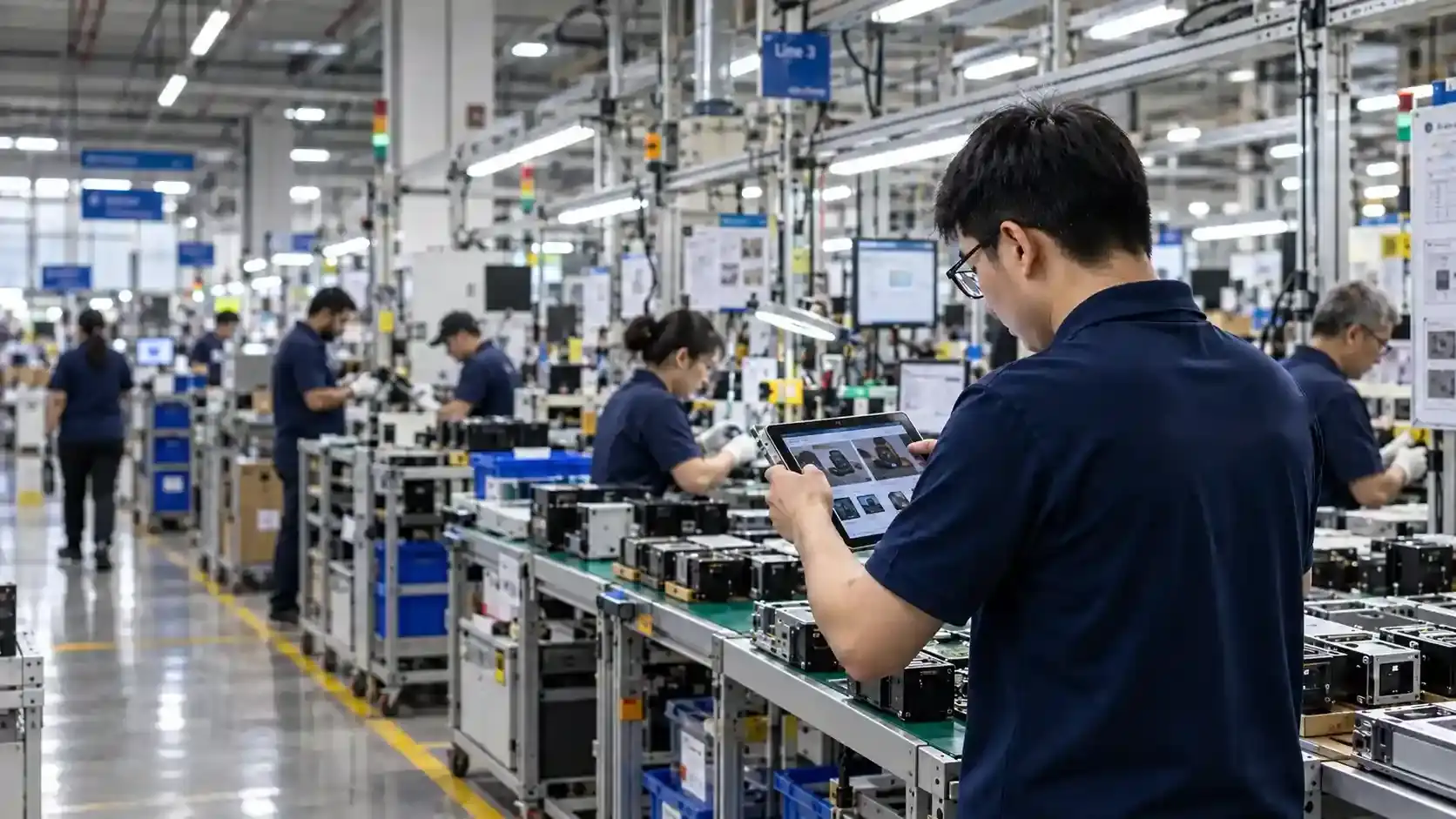
A China factory audit can help a buyer understand whether a supplier’s production site, equipment, workflows and quality controls appear suitable for a specific order. It is most useful when the order is important enough that uncertainty about capacity, process control or site operations could create a meaningful loss.
An audit is not a guarantee that a supplier will deliver correctly. It is a structured review at a particular time, within an agreed scope. The buyer still needs clear specifications, commercial terms, appropriate product checks and a plan for dealing with findings.
Factory audit vs. supplier verification vs. product inspection
These checks answer different questions and should not be treated as interchangeable.
| Check | Main question | Typical evidence |
|---|---|---|
| Company / supplier verification | Does the legal entity exist, and are its identity and transaction details consistent? | Registration information, legal name, address, contracting and payment details |
| Factory audit | Does the relevant site appear capable of producing the product under the required conditions? | Facilities, equipment, capacity, workflow, quality systems, records and identified gaps |
| Product inspection | Do selected products or a production lot meet the agreed requirements at a particular stage? | Measurements, test results where applicable, sample findings, defect records, packaging and quantity checks |
| Laboratory testing | Does a sample meet specified technical, safety or material tests? | Test report from a suitable laboratory for the defined sample and test scope |
QIMA distinguishes manufacturing audits, which assess facilities, capabilities, quality systems and workflows, from product inspections, which check products at a particular production stage. The distinction matters: a well-organised factory can still produce a defective batch, and a good inspection result does not prove that the factory has strong systems for every future order.
When is a factory audit worth considering?
The right level of review depends on the product, order value, complexity and consequences of failure. Consider an audit when:
- You are onboarding an unfamiliar manufacturer for a meaningful first order.
- The product requires specialised equipment, controlled processes or repeatable tolerances.
- The supplier claims a production capacity that materially affects your delivery plan.
- Several subcontractors or production sites are involved and the responsibilities are unclear.
- Past orders show repeated quality issues, delays or unexplained changes.
- You are increasing order volume and need evidence that the current setup can support the increase.
A full on-site audit may not be cost-effective for every low-value, standard item. In those cases, a narrower desk review, video walkthrough, sample evaluation or product inspection may address the most important uncertainty first. These methods are not equivalent to a full audit; choose them with a clear understanding of what remains unverified.
1. Define the audit objective before booking
Do not request a vague “factory audit” without stating what decision the findings must support. A general manufacturing audit, a technical process audit, a social-compliance audit and an environmental audit have different scopes. One audit does not automatically cover every topic.
Write a short audit brief with:
- The supplier’s legal name and the exact factory address to be assessed.
- The product, process and order quantity the site is expected to support.
- The specific decision: initial supplier approval, capacity review, corrective-action follow-up or another defined purpose.
- Required checks, such as equipment, production flow, incoming materials, traceability, testing, packing or subcontracting.
- Any product-specific, safety, social, environmental or customer requirements that must be included.
- The required report format, evidence, severity ranking and follow-up expectations.
Ask the audit provider to list what is included and excluded. Confirm whether the audit will be announced, what areas and records the auditor may access, how long the visit will take, and what happens if key evidence cannot be reviewed.
2. Verify the site and production arrangement
Before reviewing equipment, establish which entity and location are actually relevant to your order. Compare the legal seller, stated manufacturer, factory address, quotation, contract and any supplied registration information. If the seller uses a separate manufacturing entity or subcontractor, ask for the relationship and responsibilities to be documented.
During the audit, the reviewer should distinguish between the registered address, office, warehouse and production site. Ask whether the production area shown is the site that would make your product and whether critical operations are performed there or elsewhere.
A registered business record can support identity checks, but it does not establish that a particular production line exists or that the site can meet your requirements. Likewise, a factory tour or video is only one source of evidence. Record what was observed, what documents were checked and what could not be independently confirmed.
3. Review facilities, equipment and capacity
The aim is not simply to count machines or workers. The audit should consider whether the relevant process, equipment and available capacity match the product and order.
- Equipment and process fit: Are the necessary machines, tools, fixtures and process steps present and appropriate?
- Maintenance and calibration: Where measurements or process settings matter, are maintenance and calibration controls documented and current?
- Capacity and workload: How is output calculated, what is the current order load, and which process could constrain the promised timeline?
- Workflow: Are materials, work-in-progress, rework and finished goods identified and moved through a defined process?
- Subcontracting: Which operations occur off-site, who selects those providers, and how are their outputs checked?
- Storage and handling: Are materials and products protected from damage, contamination, moisture or mix-ups where relevant to the product?
Capacity estimates should be treated as estimates unless supported by suitable records and assumptions. A site’s maximum theoretical output is not necessarily its available capacity for your order, especially when existing orders, changeovers, yield loss or subcontracted steps are involved.
4. Assess the quality management system in practice
Documents matter only if they reflect what actually happens. The audit should check whether the supplier has defined responsibilities, controlled specifications, incoming material checks, process controls, final checks, nonconformance handling and corrective action appropriate to the product.
Useful evidence may include:
- Current work instructions and approved specification revisions.
- Incoming material records and supplier approval controls, where relevant.
- In-process checks and records tied to production batches or lots.
- Inspection equipment and evidence of calibration where measurement accuracy matters.
- Defect, rework, customer complaint and corrective-action records.
- Traceability practices linking materials, production records and finished goods.
- Controls for engineering changes, substitutions and subcontracted processes.
Ask the auditor to sample actual records and compare them with observed practice, rather than merely checking whether a procedure exists. A quality-management certificate may provide context, but it does not prove that every process relevant to your product is controlled or that your product meets its specification.
5. Add specialist modules only when relevant
A manufacturing audit can be extended to cover other concerns, but these should be explicitly scoped. Examples include social responsibility, worker health and safety, environmental practices, product-specific technical processes, hygiene, or requirements associated with a particular customer or market.
Do not assume that a general manufacturing audit verifies legal compliance in every jurisdiction or certifies the product for sale in the destination market. If the product is regulated, identify the applicable requirements independently and use an appropriately qualified testing or compliance provider where needed.
6. Read the findings by severity, evidence and business impact
A useful audit report should identify findings clearly enough that the buyer can decide what to do next. For each finding, look for:
- The requirement or expected control.
- The evidence observed or record reviewed.
- The gap or nonconformity.
- The risk to product quality, delivery, worker safety, compliance or order execution.
- The corrective action, owner, due date and evidence needed to close it.
Do not rely on an overall score alone. A high score can conceal a single critical issue, while a low-priority housekeeping issue may not prevent a supplier from making a particular product. Prioritise findings according to the defined audit scope and the consequence of failure.
| Example finding | Possible buyer response |
|---|---|
| Critical process or required equipment cannot be demonstrated | Pause approval until the capability is verified or select another supplier |
| Traceability records are incomplete for a critical material | Require a corrective action and evidence before production, or define additional controls |
| Capacity estimate is unsupported or conflicts with the order schedule | Reconfirm the timeline and capacity assumptions before committing |
| Documentation is outdated but the underlying process appears present | Set a documented correction deadline and verify completion |
| Optional improvement unrelated to the order’s critical risks | Record it for improvement without automatically treating it as a disqualifier |
These are examples, not universal pass/fail rules. The actual decision depends on product risk, contract requirements and the audit evidence.
7. Require a corrective-action plan where needed
An audit is most useful when findings lead to clear actions. Ask the supplier to state the root cause, correction, preventive action, responsible owner, deadline and proof of completion. For material findings, decide whether desk evidence is enough or whether a follow-up visit is needed.
Closing an audit finding does not automatically prove that the product will pass inspection. For example, improving a documented process may reduce risk, but the first production run still needs checks against the approved specification. Keep audit follow-up and product acceptance as separate controls.
8. Understand the limits of a factory audit
An audit is a time-bounded review of a defined site and scope. It may not reveal concealed information, future changes, every subcontractor, all production shifts or every defect in a later batch. The result also depends on access to records, cooperation, auditor competence and the evidence available during the visit.
Use the report as one input to a broader supplier decision. Combine it with company verification, comparable quotations, sample approval, written contract terms and risk-appropriate product inspection. Reassess when the supplier changes site, ownership, key process, subcontractor or production scale.
Factory audit checklist for buyers
AUDIT PURPOSE
- Decision and scope defined
- Product, process, quantity and destination identified
- Factory address and legal entities recorded
- Audit modules and exclusions agreed

SITE AND CAPABILITY
- Actual production site identified
- Relevant equipment and processes observed
- Capacity assumptions and current workload reviewed
- Subcontracted steps disclosed
- Material and finished-goods storage reviewed

QUALITY SYSTEM
- Specification and document control checked
- Incoming material controls reviewed
- In-process and final checks reviewed
- Measurement equipment controls reviewed where relevant
- Defect, rework and corrective-action records sampled
- Traceability and change-control practices checked

REPORT AND FOLLOW-UP
- Evidence and limitations recorded
- Findings ranked by business impact
- Corrective actions, owners and deadlines assigned
- Critical gaps resolved before supplier approval
- Product inspection and sample approval planned separately
Frequently asked questions
Does a factory audit prove a supplier is reliable?
No. It provides evidence about the site and controls within the audit scope at a particular time. Future performance also depends on the product specification, materials, workload, people, changes and execution of the actual order.
Is a factory audit the same as a pre-shipment inspection?
No. A factory audit assesses the supplier’s facilities, capabilities and systems. A pre-shipment inspection checks selected finished goods against agreed requirements near shipment. The checks answer different questions and may both be appropriate.
Do I need an independent audit provider?
That depends on risk, required independence, technical complexity and available internal capability. If you use a third party, agree the scope, auditor qualifications, report deliverables, exclusions and follow-up process before booking.
Can a remote video audit replace an on-site audit?
A guided video review may help resolve limited questions or screen a candidate, but it cannot observe all site conditions or independently verify every record. Decide whether the remaining uncertainty is acceptable for the order.
Final takeaway
A factory audit should answer a defined purchasing question—not simply produce a score or certificate. Scope the right checks, assess the actual production site and quality controls, review findings by risk, and follow up on corrective actions. Keep supplier identity checks, sample approval and product inspection separate. If you need help organising supplier research or reviewing available supplier evidence, see Sourzio’s supplier verification support and China sourcing support to confirm what can be delivered within an agreed project scope.