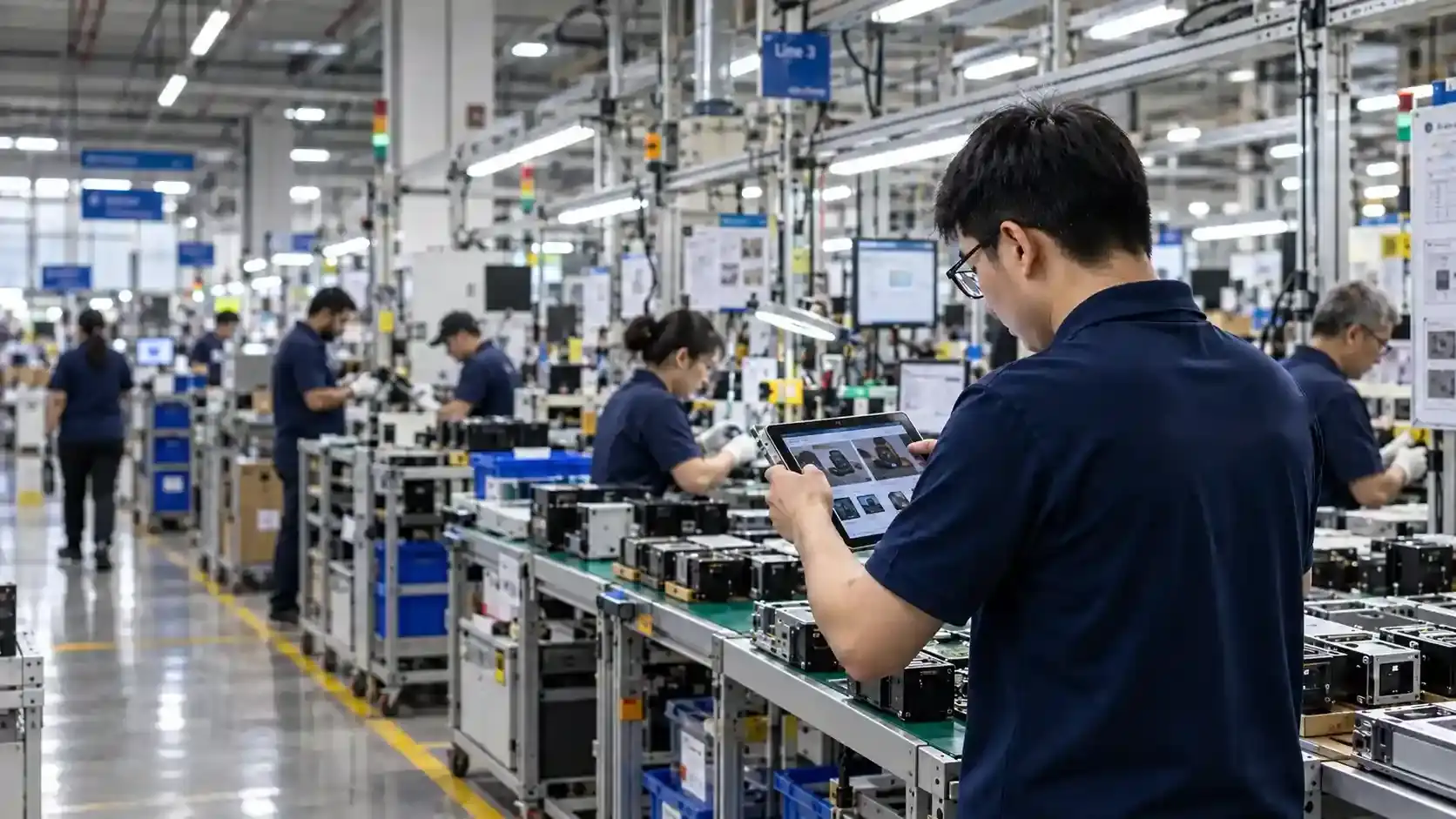
You find a supplier on Alibaba offering an attractive price. Their profile says "Manufacturer," and their website displays factory photos.
But does the company actually manufacture your product?
When sourcing from China, understanding whether you're dealing with a manufacturer, a trading company, or a business operating through multiple related entities can affect pricing, production control, quality assurance, and contractual responsibility.
The important question isn't simply whether a trading company is better or worse than a factory.
It's who actually produces your goods, who controls the important production processes, and which company is responsible for your order.
This guide explains how to investigate those questions before committing to a significant purchase.
1. Manufacturer vs Trading Company: What's the Difference?
A manufacturer produces goods through facilities and processes it owns, operates, or controls.
A trading company primarily sources products from manufacturers and sells them to buyers. It may also coordinate samples, quotations, inspections, shipping, and communication.
Some companies combine both activities or use separately registered manufacturing and export businesses.
Manufacturer vs Trading Company Comparison
| Factor | Manufacturer | Trading Company |
|---|---|---|
| Main role | Produces goods | Sources and sells goods |
| Production facilities | Usually operates or controls relevant production | May use third-party factories |
| Product range | Often focused on specific manufacturing capabilities | May cover multiple product categories |
| MOQ | Depends on production economics | May offer flexible quantities |
| Pricing | May offer competitive direct pricing | May include coordination and trading costs |
| Customization | Potentially direct access to production teams | Depends on factory partnerships |
| Communication | Depends on export experience | May provide dedicated international sales support |
| Quality control | Can manage internal production processes | May coordinate controls across factories |
| Best suited for | Technical, customized, or repeat manufacturing orders | Mixed-product sourcing, coordination, or smaller projects |
These are general tendencies, not guarantees.
A capable trading company may outperform a poorly managed factory. Likewise, a manufacturer may offer excellent international customer service.
Choose based on documented capabilities and your purchasing requirements, not company labels alone.
2. Check the Chinese Business License
One useful starting point is the supplier's Chinese business license, called 营业执照 (Yíngyè Zhízhào).
Request the company's full registered Chinese legal name and Unified Social Credit Code.
These details can help you compare the supplier's claims with available company registration records.
Important Chinese Business License Fields
| Chinese Field | English Meaning | What to Check |
|---|---|---|
| 名称 | Registered company name | Does it match the contracting entity? |
| 统一社会信用代码 | Unified Social Credit Code | Can the company be identified consistently? |
| 经营范围 | Business scope | Does it include relevant manufacturing or trading activities? |
| 住所 | Registered address | Is it consistent with the company's explanation? |
| 法定代表人 | Legal representative | Is the registered information consistent? |
| 成立日期 | Establishment date | Does it match the company's history claims? |
Business license layouts and available fields may vary by jurisdiction and registration format.
Manufacturing-Related Chinese Terms
Common terms that may appear in a company's business scope include:
- 生产 — Production
- 制造 — Manufacturing
- 加工 — Processing
- 组装 — Assembly
- 销售 — Sales
- 批发 — Wholesale
- 进出口 — Import and export
- 贸易 — Trading
Important: A manufacturing-related business scope does not prove that a company currently operates a factory or manufactures the specific product you intend to purchase.
Similarly, a trading-related business scope does not necessarily mean the business has no manufacturing relationships or that it is unsuitable for your project.
Business registration information is one piece of evidence, not a complete factory verification.
3. Verify Company Registration Information
For a preliminary check, you can use China's National Enterprise Credit Information Publicity System.
Official website: https://www.gsxt.gov.cn/
Where accessible, search using the supplier's registered Chinese company name or Unified Social Credit Code.
Look for:
- Company registration status.
- Registered legal name.
- Business scope.
- Registered address.
- Available administrative or regulatory information.
- Material inconsistencies with information provided by the supplier.
Some information may be incomplete, unavailable, or difficult to access. Official records can also have reporting delays.
If you find conflicting information, request clarification and supporting documents.
Example: An Identity Mismatch
The following scenario is fictional and provided for illustration.
A supplier introduces itself as "ABC Precision Manufacturing" in English.
However, its quotation contains a different Chinese company name, and its requested payment beneficiary belongs to another business.
This does not automatically establish fraud.
The companies might be related, or one might provide export services.
Nevertheless, the buyer should confirm:
- Which legal entity owns the quotation?
- Which entity will sign the purchase agreement?
- Which company will manufacture the products?
- Why is the payment beneficiary different?
- What evidence connects these companies?
Do not transfer funds based solely on an informal explanation of the relationship.
4. Ask Who Actually Manufactures Your Product
A supplier's business identity and its actual manufacturing role are not always the same.
For example, a registered manufacturer might outsource some processing stages. A trading company may work exclusively with a long-term manufacturing partner.
Ask the supplier to explain the production chain for your specific order.
Seven Questions Worth Asking
- Which company will manufacture the product?
- What is the actual production facility address?
- Which manufacturing stages are performed at that facility?
- Are any critical processes subcontracted?
- Who controls production quality and corrective actions?
- Can the supplier provide relevant production evidence?
- Can the buyer arrange an independent inspection when necessary?
A supplier that cannot immediately answer every technical question is not automatically unreliable.
However, vague or contradictory responses should be documented and clarified before placing a substantial order.
5. Evaluate Factory Evidence Carefully
Factory photos and production videos may help explain a supplier's operations, but they are not conclusive proof of ownership or production capability.
Ask for evidence relevant to your actual product and manufacturing process.
Evidence Comparison
| Evidence | What It May Support | What It Cannot Prove Alone |
|---|---|---|
| Chinese business license | Registered identity and business scope | Current production activity |
| Factory photographs | Appearance of a production facility | Ownership or control |
| Live factory video call | Access to a visible facility | Long-term production capability |
| Equipment information | Potential manufacturing processes | Equipment availability for your order |
| Production schedule | Planned manufacturing activities | Guaranteed delivery |
| Product certificates | Specific documented compliance claims | Compliance of every product or batch |
| Independent inspection | Conditions observed within inspection scope | Future quality of every shipment |
For higher-value or technically complex orders, consider whether an independent factory audit, sample evaluation, or production inspection is appropriate.
The appropriate level of verification depends on order value, product risks, and available evidence.
6. Identify the Real Risks Behind Supplier Structures
A trading company is not inherently risky, and a factory is not inherently safe.
The most important risks often come from unclear responsibilities.
Risk 1: Unknown Production Location
A buyer may not know where the product will actually be manufactured.
Suggested action: Confirm the production facility and any material subcontracting arrangements.
Risk 2: Uncontrolled Supplier Changes
A trading company may source the same product from different factories.
Suggested action: Where consistency matters, agree on production-site disclosure and approval requirements.
Risk 3: Unclear Quality Responsibility
When a defect occurs, the seller and manufacturer may disagree about who should investigate or correct the problem.
Suggested action: Clarify contractual quality requirements, inspection arrangements, and remedies before ordering.
Risk 4: Unverified Payment Relationships
The quotation, contract, and bank account may involve different legal entities.
Suggested action: Verify the identity and authorization of each relevant party before payment.
Risk 5: Inaccurate Production Capability Claims
Marketing materials may describe capabilities that are outsourced, outdated, or unavailable for your order.
Suggested action: Request product-specific supporting evidence and consider independent verification when justified.
7. When Should You Choose a Manufacturer?
Buying directly from a manufacturer may be preferable when your project requires:
- Custom tooling or engineering.
- Detailed technical communication.
- Repeat orders with consistent specifications.
- Direct coordination of production changes.
- Specialized manufacturing processes.
- Greater transparency into production controls.
However, direct manufacturers may have higher MOQs, narrower product ranges, or limited support for small international buyers.
Before choosing, verify whether the manufacturer can handle your order quantity, communication requirements, documentation, and delivery arrangements.
8. When Can a Trading Company Be the Better Choice?
A trading company may be useful when you:
- Purchase multiple product categories.
- Need to consolidate products from several factories.
- Require smaller or mixed orders.
- Prefer one point of communication.
- Need help coordinating samples and suppliers.
- Lack the time to manage several manufacturing relationships.
A reliable trading company can provide real commercial value.
The key is understanding what services it performs, how it manages its manufacturers, and who is accountable for the goods.
The right question is not "How do I avoid every trading company?" but "Does this supplier structure meet my purchasing requirements?"
9. Ready-to-Send Supplier Verification Email
Use this template when a supplier claims to manufacture the products it sells.
Subject: Supplier Company and Manufacturing Information Confirmation
Dear Sales Team,
Thank you for your quotation.
Before proceeding with our supplier evaluation, we would appreciate clarification of the following information:
- Your full registered Chinese company name.
- Your Unified Social Credit Code and business license.
- Whether your company manufactures the quoted product directly or sources it from another manufacturer.
- The address of the facility that would produce our order.
- The main manufacturing processes performed at that location.
- Whether any critical manufacturing stages are outsourced.
- The legal entity that would sign our purchase agreement.
- The legal entity that would receive payment.
- Whether an independent factory inspection could be arranged if required.
Please let us know if any information requires clarification or supporting documents.
We understand that manufacturers and trading companies can both be suitable suppliers. Our purpose is to understand the supply structure and confirm the responsibilities relevant to our purchasing project.
Thank you for your cooperation.
Best regards,
[Your Name]
[Company Name]
What to Do After Receiving the Response
Compare the supplier's answers with its quotation, business registration information, and available supporting documents.
If information is missing, record it as Not Confirmed.
Do not treat an unanswered question as evidence of wrongdoing, but avoid relying on unsupported claims when making important purchasing decisions.
10. Supplier Identity Verification Checklist
Company Identity
- Registered Chinese legal name obtained.
- Unified Social Credit Code obtained.
- Registration information reviewed where available.
- Business scope assessed in context.
- Contracting entity identified.
- Payment beneficiary relationship clarified.
Manufacturing Capability
- Actual production facility identified.
- Relevant manufacturing activities clarified.
- Critical subcontracting arrangements discussed.
- Product-specific production evidence reviewed.
- Independent verification considered where appropriate.
Commercial Responsibility
- Supplier quotation identifies the responsible seller.
- Product specifications are documented.
- Quality responsibilities are agreed.
- Production-site changes are addressed where relevant.
- Payment instructions have been independently verified.
- Material uncertainties are resolved or explicitly accepted.
This checklist supports preliminary due diligence. It is not a certification of supplier reliability.
11. Frequently Asked Questions
How do I know if an Alibaba supplier is a real manufacturer?
Start with its registered Chinese company identity, business scope, and explanation of who performs the relevant production processes. Request supporting evidence when necessary. A platform label or factory photograph alone is not enough.
Are Chinese trading companies always more expensive?
No. Trading companies may add a commercial margin, but they can also negotiate favorable manufacturing prices or reduce coordination costs. Compare total purchasing costs and services.
Can a Chinese company be both a manufacturer and a trading company?
Yes. A company may manufacture some products and source others externally. Related manufacturing and export businesses may also operate through separate legal entities.
Does a Chinese business license prove a company owns a factory?
No. It helps establish registered identity and permitted business activities. Factory ownership, operating control, and actual manufacturing capability require additional evidence.
Is buying directly from a factory always safer?
No. Supplier reliability depends on product suitability, quality management, financial and contractual responsibility, and other project-specific factors.
Can Sourzio help check whether a supplier is a manufacturer?
Sourzio offers supplier information research and verification support. The available scope may include reviewing public company information, comparing supplier claims, identifying inconsistencies, and highlighting matters requiring further confirmation.
On-site factory audits or independent inspections require separate arrangements and scope confirmation.
Need Help Verifying a Chinese Supplier?
Already found a Chinese supplier but uncertain whether you're dealing with the actual manufacturer?
Sourzio helps international buyers review available supplier information and identify questions that should be resolved before purchasing.
Depending on the agreed scope, we can assist with:
- Chinese company identity research.
- Business registration information checks.
- Supplier claim consistency reviews.
- Company and payment-entity questions.
- Structured supplier information summaries.
- Identification of unresolved verification concerns.
To discuss your supplier, share the company name, website or supplier profile, product category, and the specific information you want to check.
Related services and guides:
- China Supplier Verification
- China Sourcing Agent & Procurement Support
- How to Compare Chinese Supplier Quotations
This guide provides general information about supplier due diligence. Business registration checks and publicly available evidence cannot guarantee supplier reliability, product quality, or the outcome of a commercial transaction.