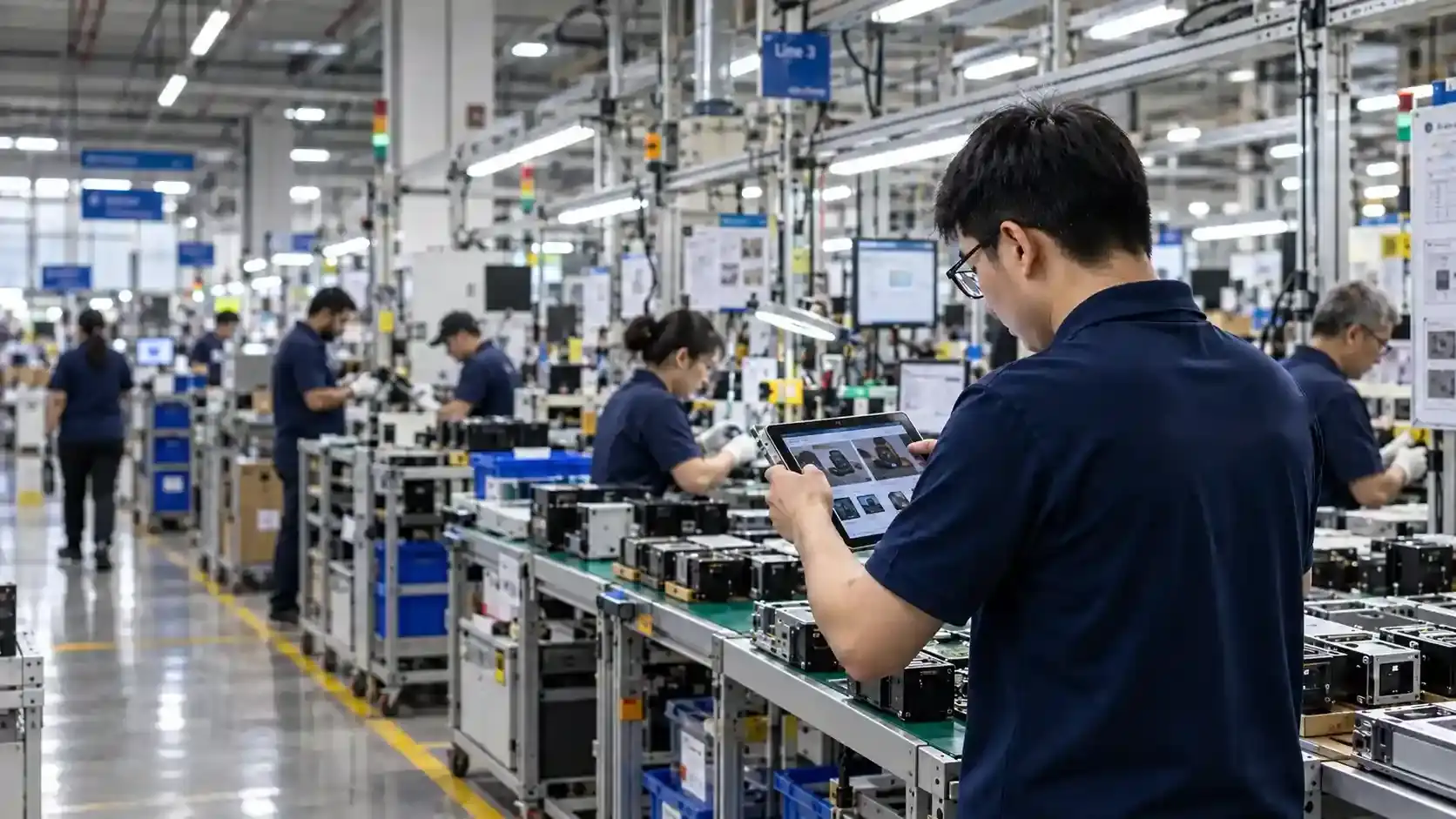
Finding a manufacturer in China starts with a clear product requirement and ends only after the strongest candidate has been tested against that requirement. A search result, trade-fair listing or factory video can create a lead, but none of those alone proves that the company can manufacture your exact product at the required quality, quantity and timing.
This guide focuses on factory discovery and manufacturing capability. For a broader process covering factories, trading companies and other supplier types, see the guide to finding reliable Chinese suppliers.
1. Prepare a manufacturing brief before searching
Manufacturers can only evaluate a requirement that is described clearly enough. Before contacting candidates, assemble what you know and label anything still undecided.
- Product definition: product function, intended use, material and grade, dimensions, tolerances, finish, colour and critical performance requirements.
- Technical files: drawings, 3D models where useful, reference photos, artwork, packaging files and a revision number.
- Quantity: first order, variants, expected repeat volume if known, and whether a pilot run is possible.
- Destination: target market and any known product safety, testing, labelling or documentation requirements.
- Commercial boundaries: target timing, sample budget, tooling constraints and required delivery basis.
- Acceptance criteria: what makes a sample or production unit acceptable, including how important defects will be treated.
Do not invent tolerances, standards or certification requirements. If a technical or regulatory requirement needs professional confirmation, list it as an open item. A good manufacturer should be able to identify questions that need clarification before quoting.
2. Search where relevant manufacturers are likely to appear
Use a small set of channels matched to your product category and process. The aim is to find candidates with relevant capability, not simply to collect the largest number of names.
| Discovery channel | How to use it | Follow-up check |
|---|---|---|
| B2B marketplaces | Search by product, material, manufacturing process and custom capability; compare detailed listings and company profiles | Ask which process is done in-house and verify the contracting entity separately |
| Trade-fair exhibitor lists | Search exhibitors in the relevant product category and review their technical focus | Confirm that the company is currently active in the required product and order size |
| Industry associations and specialist directories | Look for firms organised by process, component or product segment | Check listing criteria and do not treat membership as proof of capability |
| Referrals and industry contacts | Ask for suppliers with experience in a comparable product or process | Ask what was actually purchased, when, and at what order scale |
| Search engines and manufacturer websites | Search with process terms, product specifications and relevant Chinese or English terms | Check whether evidence refers to the actual company and site, not copied marketing material |
Search by manufacturing process as well as product name. A product may require injection moulding, CNC machining, metal stamping, textile cutting and sewing, electronics assembly or several processes together. A supplier that sells a finished product may outsource the critical step; that may be acceptable, but it must be understood and controlled.
3. Separate “manufacturer” claims from evidence of capability
Do not make the decision from one label. Ask the company to explain its role in the product and identify the steps it performs itself.
- Which manufacturing processes are carried out at the named site?
- Which steps are subcontracted, and how are those subcontractors controlled?
- What equipment or production line is relevant to this product?
- Who controls materials, process settings, in-process checks and final release?
- Can the company show a live or recent view of the relevant area, subject to confidentiality and safety rules?
- What part of the process would be the capacity constraint for this order?
A trading company is not automatically unsuitable, and a factory is not automatically reliable. The important issue is whether the company’s role is transparent and whether responsibility for specifications, quality, delivery and corrective action is clear. If a trader manages a specialist production network, assess that network and its controls rather than relying on the label alone.
4. Check the legal entity and production site
Request the company’s legal name in Chinese, Unified Social Credit Code where applicable, registered address and the address of the production site relevant to your order. Compare the details with the quotation, contract, invoice, certificates and payment instructions.
The National Enterprise Credit Information Publicity System is an official source for basic registration information about Chinese enterprises. The record can help you check the registered entity and business information, but it does not prove that the company owns the factory shown in a video or has the equipment and capacity needed for your product.
If the registered seller and manufacturing site belong to different entities, ask the supplier to explain the relationship and document who will contract, manufacture, inspect, invoice and receive payment. Some arrangements are legitimate; an unexplained mismatch is a reason to pause.
5. Verify technical fit before negotiating only on price
Send the same revision of your manufacturing brief to each shortlisted candidate. Ask the supplier to confirm every must-have requirement and list deviations separately. Compare how well the supplier understands the process, not just the speed or confidence of the sales response.
For a customised product, useful evidence may include:
- Answers to material, process, tolerance or tooling questions that are specific to the design.
- Examples of comparable products or processes, with confidential customer information removed.
- Relevant equipment or process capability information.
- A clear explanation of the proposed sample, testing and approval sequence.
- A list of technical assumptions and items that cannot yet be confirmed.
Where the design is complex, have a qualified engineer review the technical feasibility and acceptance criteria. Do not treat an AI-generated checklist or a supplier’s verbal assurance as an engineering approval.
6. Review certificates and quality systems carefully
Ask which quality controls apply to the product and which certificates or test reports are relevant. Verify important documents with the issuer or official database where available. Check the named legal entity, production site, scope, model or product family, status and date.
A quality-management certificate is not the same as product certification, and a product test report may apply only to a specific sample or model. A document can be authentic yet not cover your actual item. If the destination market has mandatory requirements, confirm them independently with an appropriate compliance specialist or testing organisation.
Ask how the manufacturer controls incoming materials, production changes, traceability, nonconforming products and corrective action. A certificate is useful context, but a practical explanation of controls and evidence from the relevant process are needed to assess fit.
7. Use a factory capability review proportionate to risk
Depending on order value, product risk and the amount of uncertainty, you may use a live video walkthrough, a local visit, a specialist factory audit or a third-party assessment. Agree in advance what the check will cover and what evidence will be delivered.
A useful review can examine:
- Whether the relevant production area and equipment exist at the stated site.
- Whether the process appears suitable for the product and expected volume.
- How materials, work-in-progress and finished goods are identified and controlled.
- How inspection records, defects, rework and customer complaints are handled.
- Whether the stated capacity and lead time have a credible basis.
- Which operations are outsourced and how changes are approved.
A short video call is not equivalent to an independent factory audit. A formal audit also has limits: its conclusions depend on the scope, duration, access, evidence and date of assessment. Record what was checked and what remained unverified.
8. Request and evaluate a sample against written criteria
A sample helps test product fit, but the result is useful only when you know what you are evaluating. Before ordering it, agree the material, version, colour, finish, dimensions, functionality, packaging and any relevant tests. Keep photos and notes tied to the sample reference.
For a customised product, clarify whether the sample is hand-made, produced with temporary methods or made using the intended production process and tooling. Ask what would change between the approved sample and mass production. If tooling or setup costs are involved, document the cost, ownership and permitted use.
Do not approve a sample merely because it looks acceptable in a photo. Where performance, fit, electrical safety, material composition or other technical properties matter, use appropriate measurement or testing. A successful sample does not guarantee that later production will be identical; the order should also define production controls and acceptance criteria.
9. Compare candidates using a manufacturer scorecard
| Criterion | Questions to answer | Evidence status |
|---|---|---|
| Process fit | Can the site perform the critical manufacturing steps? | Confirmed / partial / unknown |
| Technical fit | Are specifications understood and deviations documented? | Confirmed / partial / unknown |
| Quality control | Are inspection, traceability and corrective action appropriate? | Confirmed / partial / unknown |
| Capacity and timing | Can the supplier support the quantity and timeline with credible assumptions? | Confirmed / partial / unknown |
| Commercial terms | Are MOQ, tooling, price, payment and exclusions clear? | Confirmed / partial / unknown |
| Identity and accountability | Are the seller, factory, invoice and payment arrangements explained? | Confirmed / partial / unknown |
| Problem handling | Can the supplier explain how defects, delays and changes are handled? | Confirmed / partial / unknown |
Use the scorecard to identify gaps, not to create false precision. An unknown critical requirement should remain a decision blocker until it is checked. The lowest quote should not win if the supplier cannot demonstrate the capability your product depends on.
10. Start with a controlled first order
Once a candidate passes the checks that matter for your product, define the first order carefully. Confirm the final specification revision, sample approval, tooling, packaging, inspection criteria, delivery milestones, payment terms, remedies for deviations and the identity of the contracting party.
For a new or higher-risk supplier, consider a limited order or pilot quantity if commercially feasible. Decide what evidence must be supplied at each milestone and what happens if the product fails acceptance. Use independent inspection or testing where the cost of failure justifies it. Do not scale solely because the first conversation or sample went well.
Copyable manufacturer inquiry
Subject: Manufacturing Capability Inquiry – [Product / Process]

Hello,

We are looking for a manufacturer for the following requirement.

Product: [product]
Key process / material: [process and material]
Specification reference: [drawing or document revision]
Initial quantity: [quantity and variants]
Destination market: [country]
Required timing: [date or range]

Please clarify:
1. Which manufacturing steps are performed at your site?
2. Which steps, if any, are subcontracted?
3. What information is still needed to confirm feasibility and price?
4. What are your MOQ, sample process and tooling/setup costs?
5. How do you control materials, production changes and nonconforming items?
6. What relevant quality documents or test reports are available?
7. What are the estimated sample and production lead times, and their start conditions?
8. Which legal entity would contract, invoice and receive payment?

Please identify assumptions, exceptions and unconfirmed items separately.

Thank you.
Frequently asked questions
Is it always better to buy directly from a factory?
No. Direct factory sourcing can be useful when the buyer can manage technical clarification, export coordination and quality follow-up. A capable trading company or sourcing partner may be more suitable when the order involves multiple processes or suppliers. Compare the actual scope, cost, transparency and accountability.
Can I identify a real factory from its business licence?
A registration record helps establish legal identity and recorded business information, but it does not by itself prove the existence or suitability of a particular production line. Combine it with site-specific evidence and product-related checks.
Do I need a factory audit for every order?
Not necessarily. The appropriate level of verification depends on product risk, order value, complexity, uncertainty and the consequences of failure. A desk review may be enough to reject poor-fit candidates; a higher-risk order may justify an on-site or independent assessment.
What if the manufacturer will not share factory information?
Some limits may be reasonable because of confidentiality or safety, but the supplier should still offer enough evidence to support important claims. If the critical capability cannot be verified, record the uncertainty and decide whether the remaining risk is acceptable before committing funds.
Final takeaway
Prepare a clear brief, search by product and process, verify the legal entity and actual production arrangement, evaluate technical evidence, and test the strongest candidate with a controlled sample and first order. The aim is not to prove that a company is a factory in the abstract; it is to determine whether it can responsibly make your product under the agreed conditions. For help organising candidate research or supplier checks, review Sourzio’s China sourcing support and supplier verification support to confirm the scope that can be agreed for your project.